AI vs ML: Understanding the Key Differences in 2026
Published: January 14, 2026 | Category: Technology & Data Science
In the rapidly evolving landscape of 2026, the terms Artificial Intelligence (AI) and Machine Learning (ML) are more than just buzzwords—they are the engines driving global innovation. However, many still use them interchangeably. Understanding the nuance between these two is critical for business leaders, students, and tech enthusiasts alike.
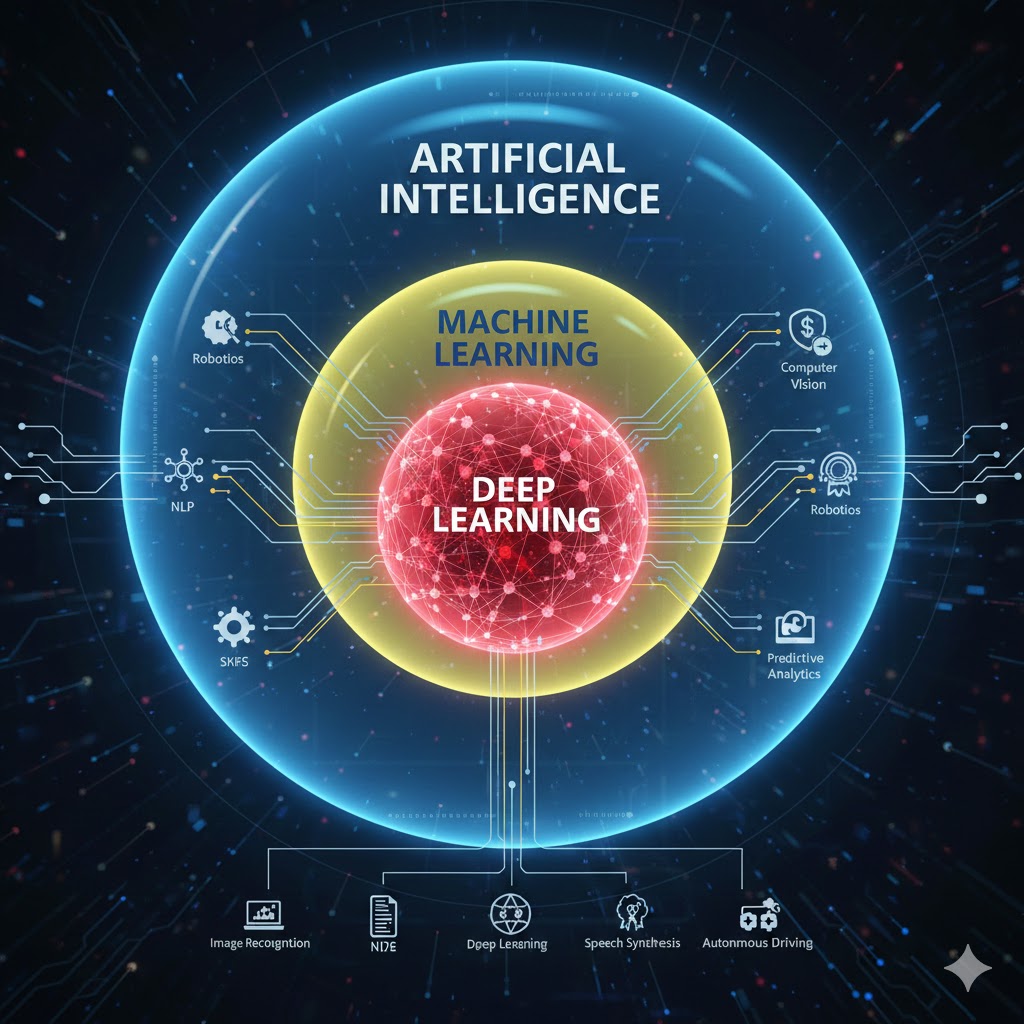
Essentially, while every ML system is a form of AI, not all AI qualifies as Machine Learning. Let’s dive into the specifics.
What is Artificial Intelligence (AI)?
Artificial Intelligence is the broad umbrella concept of creating machines capable of mimicking human cognitive functions. In 2026, AI has moved beyond simple automation to Agentic AI—systems that can reason, plan, and execute multi-step tasks autonomously.
- Goal: To simulate human-like intelligence for complex decision-making.
- Scope: Includes Robotics, Natural Language Processing (NLP), and Expert Systems.
- Example: A virtual assistant like Alexa that interprets your intent and controls your smart home.
What is Machine Learning (ML)?
Machine Learning is a specific subset of AI that focuses on the use of data and algorithms to imitate the way humans learn, gradually improving its accuracy without being explicitly programmed for every scenario.
- Goal: To identify patterns and make predictions based on historical data.
- Scope: Limited to data-driven learning and statistical modeling.
- Example: Netflix suggesting a movie based on your past viewing history.
AI vs ML: Comparison at a Glance
| Feature | Artificial Intelligence (AI) | Machine Learning (ML) |
|---|---|---|
| Concept | The broad science of mimicking human intelligence. | A specific method to achieve AI through data. |
| Objective | Maximize the chance of success in complex tasks. | Increase accuracy by finding patterns in data. |
| Learning | Can be rule-based (logic) or data-driven. | Strictly data-driven; it requires datasets to improve. |
| Human Intervention | Can operate with fixed rules or full autonomy. | Requires data scientists to tune algorithms and features. |
How They Work Together
In modern applications, these two are rarely separated. For example, a Self-Driving Car uses:
- Machine Learning: To recognize stop signs and pedestrians by analyzing millions of images.
- Artificial Intelligence: To make the executive decision to brake, swerve, or speed up based on traffic laws and safety logic.
Conclusion
As we move further into 2026, the synergy between AI and ML will continue to redefine industries from healthcare to finance. AI provides the "brain" or the framework for intelligence, while ML provides the "experience" that makes that brain smarter over time.